Showing posts with label UK. Show all posts

Monday, 30 July 2012

Olympic Gold

Did anyone catch the Olympics Opening Ceremony by any chance? Wiping out three hours of the BBC's evening schedule, it would be pretty hard to miss. Personally, I'm glad I made a point of watching; it was a fantastic celebration of our nation and I felt very proud to be British.

So often I think that as a nation we suffer from a lack of national identity. It's a fluid concept as national interests and tastes change, but most nations are known for something very specific, either in the character of the people or the character of the geography: Germany is famous for engineering and efficiency, Italy is known for flamboyancy, France is known for being insular (sometimes even xenophobic) but also for gourmet cooking, America is the nation of excess, etc., so what makes us British?

I think our lack of identity sometimes stems from the fact that we aren't one single nation. Scotland, Ireland and Wales have their own sense of identity and it's something which can drive a wedge between the people of those nations and their identity as a British National. (Scottish Independence, anyone?) In addition, I think that we are also sometimes guilty of holding on to our historical identity so steadfastly that we forget to embrace our present. Then again, our present isn't always something we would want to embrace when there's rioting in the streets, petty crime is rife and the media is in the spotlight for all the wrong reasons. However there are somethings that are completely unique to Britain and this is what Danny Boyle so successfully exploited.

We are an old nation with a history spanning millenia, not centuries. Britain was the seat of the industrial revolution and continues to be a breeding ground for some great technological wonders, celebrated in the opening ceremony by the inclusion of Tim Berners-Lee. We are recognised around the world for our British humour (so many of my overseas friends love the likes of Monty Python and Mr Bean), the British music scene is one of the most diverse and vibrant in the world and British literature is celebrated around the globe. And of course, we should celebrate the great British institutions, like the BBC and the NHS, which are both completely unique. Politically, we are both liberal and socialist, defending the rights of the individual and fiercely protecting the welfare state and institutions like the NHS, but also celebrating our monarchy. We are diverse and we are inclusive.

Danny Boyle reminded us of these facts by doing nothing more than putting on a terribly British show. For that alone, at least in my eyes, he is both a genius and a national hero.

Sunday, 11 September 2011

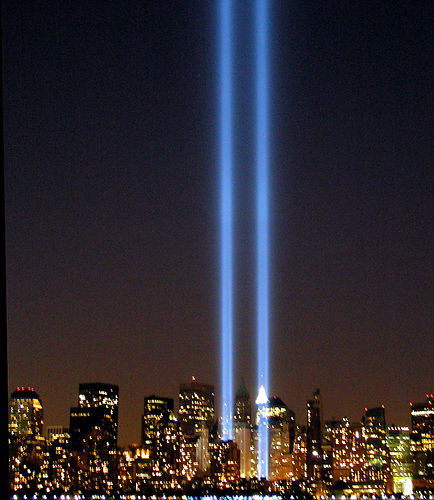
Ten Years On

Ten years ago today I was on holiday with my husband. We were broke so we'd got a cheapo deal to Tunisia. The hotel was basic, the food was dire, but it was our first anniversary on the 16th so we wanted to do something special to commemorate it. We had only been there a day or two when, passing through the TV area, a gathered crowd caught our attention. We stopped and joined their number just as the second plane hit the world trade centre.

I will never forget that day. I cannot forget the moment that I recognised the structural damage and stresses on the Twin Towers and muttered those immortal words: "Those buildings are going to come down." It has left me with a strange sort of guilt that I can't quite explain and it's a guilt that still makes my blood run a little cold. Even now, ten years later, whenever I see footage of the attack, or even just see images of the Towers in movies and on TV, I am transported back to that day and it still causes a lump to rise in my throat and a tear to form in my eye. I feel that same sense of powerlessness and there's a weight that rests on my heart for the thousands of people who lost their lives, and the families that had to carry on without them.

After we returned home from that holiday, I remember writing about the tragedy. I wrote about how it made me feel and about my hopes for the future. Everyone was already saying that this event was a game changer; I hoped that would be the case. I hoped that the scale of the tragedy would make terrorism (on any level) so unthinkable, that innocents would never again have to die in the name of a cause they were not connected to. I also hoped that the reaction of the Western World would be mighty and that it would be etched in the memories of foreign nations forever so they would know not to mess with us again. But I desperately wanted it to be the right response, one that was reasonable and measured and one that punished those responsible rather than the innocent.

What we hope for so rarely comes to fruition.

But there's still time.

As we look back and remember where we were and how we felt and as we remember the innocents that died, and the wider impact of those deaths, lets not forget the time between now and then, the good that has come out of 9/11, and also the evil. As we remember the 2,977 victims of that day, we should also remember the thousands that have lost their lives or suffered injury since then as a result of the wars in Iraq and Afghanistan. Let us also think of the terrible things that happen every day, from events that have a national impact like the 7/7 bombings or the recent riots, to the things that you don't always hear about like robberies, assaults and rapes. For the sake of the victims of 9/11, let us take our anger, our outrage and our fear and turn it into something more productive. Let's live our lives in a way that makes our world a better place; the only way that will happen is if we choose to be compassionate, considerate and thoughtful towards each other.

Tuesday, 21 April 2009

Speed Kills....

The news media is rife, today, with reports that the government is to enter into a consultation to reduce national speed limits on trunk roads (A-roads) from 60 mph to 50 mph, as well as making it easier for councils to reduce local level speed limits to 20 mph. It has been reported that "road safety researchers say people hit at 20 mph have a much better chance of survival than those struck at 30 mph" (Sky News). I'm sure, in a few months, the same road safety researchers will add to this blindingly obvious statement by telling us that those who are not struck in an accident have a much better chance of survival than those hit at 20 mph! At what point will they advocate that we all get out and push?

I'm not against speed limits as long as they are sensible, but to me, this plan seems the height of mediocrity: It's an ill conceived, reactionary proposal designed to do nothing more than appeal to the very shallowest of voter sympathies... because who would rather see some poor kid run over at 30 mph instead of 20? Of course, some roads do warrant reduced speed limits - reducing the speed limits around schools has been proven to be very successful in reducing fatalities and there are plenty of twisty rural roads (mostly B-roads) that should generally be driven at only 40 to 50 mph - but that doesn't make a banket speed limit reduction right.

Lower speed limits entirely ignore the root of the issue. We are constantly being brainwashed with the message 'speed kills' but the fact is, it isn't the speed, or even the car, it's the driver (or sometimes even the pedestrian!) that's at fault. A gun is a dangerous weapon but it can't pull its own trigger. I believe that irresponsible and inconsiderate driving is far more dangerous than speed, not only causing accidents but also contributing to congestion (which is a contributing factor in numerous other accidents). Reducing speed limits is also likely to result in more convictions for speeding, while poor driving will continue to go unpunished, I might add. Surely, the police have better things to do with their time?

I am in favour of lowering speed limits where those limits are justified but I am unwilling to support these proposals. It's yet another example of the UK government punishing road users and it will no doubt cost millions to implement. It's about time people took responsibility for their own behaviour. We don't need the nanny state to wrap us up in yet another layer of cotton wool!

Thursday, 5 March 2009

A Licence to Print Money

Today, the Bank of England has made the decision to print more money.... because this tactic worked so well for Zimbabwe! The really troubling thing, however, is that it seems they don't actually print any more money. Instead the BoE presses a button and, by magic, the UK suddenly has £75 billion more than we had a moment ago. Can I have some, please?

It reminds me of something we were discussing at work recently. A colleague proposed that instead of pumping the billions into the banks who, lets be honest, have failed us all, we should rather give £1,000 to every UK citizen - man, woman and child. At a current UK population of nearly 61 million, that would only be £61 billion. Bargain! Especially when we consider that the banks have already cost us over £100 billion! Imagine having a grand gifted to you, right now. What would you do with it? Some people will spend it, blow it on a holiday or a shopping spree. Retail is saved! A family might pool it's cash and use it to put a deposit on a house, or to buy a new car. The housing market and manufacturing industries get a boost. Others will invest it in pensions, stock, or savings and the banks get money to lend to the rest of us. It's almost as magic as printing more money!

But seriously, regardless of the action taken thus far in the UK and abroad in the face of the recession, there is one thing that continues to bug me. Ultimately, the situation that we're in right now is because the culture and economy of the UK (and many other nations!) is built on credit. We're living in a throw-away society and we're groomed from an early age to get into debt. From the moment we enter college or university, we're offered student loans, personal loans and credit cards and the average student will leave a three year degree with over £17,000 of debt, even before they have a mortgage. As of the end of January this year, total UK personal debt stood at £1,457 billion (£1,225 billion in secured loans and £233 billion in consumer credit). When and where will this end? The government is desparately trying to get the banks lending again: why? So the UK population can get further into debt? I am by no means an expert in economics but I do know enough to realise that strong growth is not possible without an eventual correction - a crash. Therefore, it seems to me that we're standing on a precipice: we can choose to take a step back and put the breaks on spiralling personal (as well as national and commercial) debt, or we can do the opposite and run forward towards the edge at full speed.

Even if 'printing' more money works and eases the recession, I worry that all this action will amount to is the financial equivalent of plastering over cracks and hoping for the best.